


For years, blockchain in Vietnam has been discussed mainly through the swings of the crypto asset market or small-scale technology pilots that are hard to replicate for lack of data standards, sustainable operating mechanisms and interoperable platforms. Despite all the discussion, blockchain has not yet contributed in proportion to digital governance capacity and economic productivity. From 2026, this picture is expected to change as blockchain takes on the role of trusted infrastructure for authentication, tracing and independent verification at national scale.

Mr. Nghiem Minh Hoang, Senior Strategy Expert, VMatrix.
National trusted infrastructure and the priority problems to deploy now
Decision No. 2815/QD-TTg of the Prime Minister, issued on December 2, 2025, defines a list of six groups of strategic technologies to be deployed immediately: large language models (LLMs) and Vietnamese virtual assistants, AI cameras with edge processing, autonomous mobile robots, 5G mobile network systems, blockchain network infrastructure (together with application layers for traceability and crypto assets) and unmanned aerial vehicles (UAVs). Among them, blockchain is identified as the trust layer for national-scale digital applications.
The focus of this phase is to build usable data infrastructure and foundation-layer blockchain to solve the problem of scattered data that is hard to reconcile and whose integrity over time is hard to prove. In management practice, the big problem is not a lack of data, but data that is dispersed, hard to cross-check and hard to prove intact over time. This infrastructure layer therefore creates a mechanism for recording and verifying data durably, which is particularly useful for processes that require tracing accountability, such as quality management, inspection, post-audit or professional records.
Within the scope of foundation-layer blockchain, the Blockchain-as-a-Service (BaaS) and Node-as-a-Service (NaaS) models help standardize deployment and operations, significantly reducing the cost for each unit of building and managing its own. When many networks or applications run to a unified service standard, monitoring, backup, security and incident response become more feasible at national scale. Multi-chain bridges are also being built to ensure that sector-specific networks can interconnect in a controlled way, avoiding “blockchain islands” and increasing international connectivity.
On Vietnam's blockchain infrastructure, national data authentication and traceability platforms that use blockchain-integrated electronic authentication stamps are prioritized for deployment. This group has a direct impact on market management, consumer protection and improving the business environment. Unlike traditional traceability systems, which are mostly about providing information, this platform aims at data that can be verified, whose history can be traced and that is tied to the accountability of the participants.
Under the direction of Decision No. 2815/QD-TTg, the authentication and traceability platform applies to goods, services, degrees and certificates under international standards, and integrates electronic authentication stamps in a combined physical-digital form, using QR codes or RFID/NFC chips.
This approach allows real-time data collection throughout the lifecycle of the authenticated object, creating a basis for inspection, reconciliation and anomaly detection based on data rather than manual checks.
At the same time, the Government requires the development of a decentralized identity system and a verification platform under international standards. This is a key component for answering questions about data origin, the authority to confirm and third-party verifiability. When applied, traceability data is not only recorded but also has legal and governance value, supporting data interoperability among agencies and organizations while ensuring access control and privacy protection. The system will help reduce the cost of repeated document verification among organizations, support data interoperability on the principle of controlled sharing, and is especially suited to fields that need both verification and privacy protection, such as education (degrees), health care (records) or financial services (KYC/KYB).
In parallel, real-world asset tokenization is a product group of high difficulty but great potential impact on the digital economy. In essence, tokenization is not just “tagging” an asset with a code, but designing mechanisms so that ownership, usage rights or beneficial rights to the asset are recorded, transferred and reconciled in a digital, transparent and auditable way. Done right, tokenization can broaden the divisibility of ownership, add liquidity to some types of assets and cut transaction costs by reducing verification intermediaries.
In socio-economic management, real-world asset tokenization is sustainable only when accompanied by a chain of conditions: a mechanism to identify the parties, a mechanism for valuation and disclosure, a custody and supervision mechanism, and a legal framework for property rights. The practical value of putting tokenization on the priority list therefore lies in Vietnam proactively building foundational capability: infrastructure for issuance, custody and trading that meets supervision and reporting standards, and a risk management approach from the very start. If successful, tokenization can become a tool supporting capital-raising models, benefit distribution and asset management in the digital economy in a more transparent way, reducing the risk of disputes and increasing access for lawful investors.
Next is the on-chain data analytics and transaction monitoring platform. As blockchain expands, monitoring becomes a mandatory requirement for maintaining confidence in the system. On-chain data analytics and transaction monitoring platforms help track activity in real time, detect anomalies, support auditing and improve management efficiency.
In socio-economic management, this layer is especially important in two directions: for the crypto asset market, it helps identify the risk of manipulation and signs of violations; for non-financial applications such as traceability, it helps detect data fraud and breakpoints in the recording chain. In other words, this component ensures that blockchain does not merely record but can also be managed.
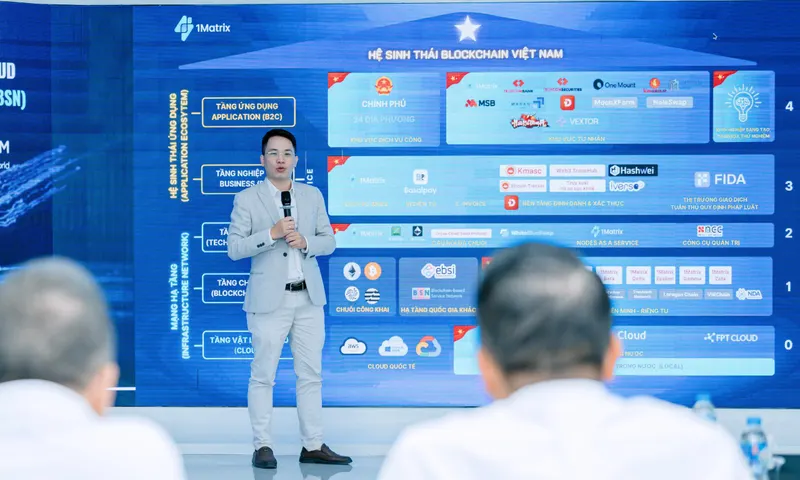
According to Mr. Nghiem Minh Hoang, 2026 is the moment Vietnam's blockchain shifts from a promising market to trusted infrastructure.
Key tests
In the 2026 deployment roadmap, two representative application directions are integrating blockchain into traceability systems and into the databases of the judicial system. These are fields with particularly high requirements for data integrity, traceability and information reliability.
For traceability, blockchain helps shift the focus from providing information to authenticating verifiable data. This helps regulators improve the effectiveness of risk-based post-audit, and helps businesses reduce the cost of proving quality and increase their ability to take part in formal supply chains.
For the judicial system, blockchain serves as a certification layer, supporting the recording of digital evidence, timestamps and processing logs. This approach increases the reliability of digital records, supports process audits and reduces the risk of disputes over data integrity, while still meeting strict security and authorization requirements.
These two fields show that blockchain is being brought into the core systems of social management, where data that is accurate, verifiable and accountable is a prerequisite. If deployed effectively, these models can set an important precedent for extending blockchain to other digital governance fields in the next phase.
VMatrix, the entity assigned to build the Vietnam Multi-Blockchain Service Network (VBSN) in 2025, took on the task of deploying the two integration problems above at the National Forum on Vietnam Technology Enterprise Development on December 30, 2025, in the presence of Deputy Prime Minister Ho Quoc Dung and Minister of Science and Technology Nguyen Manh Hung.
2026 is the year blockchain in Vietnam shifts from a promising market to trusted infrastructure, provided that policy priorities are realized through data standards, operating capability and supervision and audit mechanisms. On the legal foundation formed in 2025 and the priority product list under Decision No. 2815/QD-TTg, blockchain has a basis to expand into other areas of socio-economic life, helping raise Vietnam's digital technology competitiveness in the next phase.