

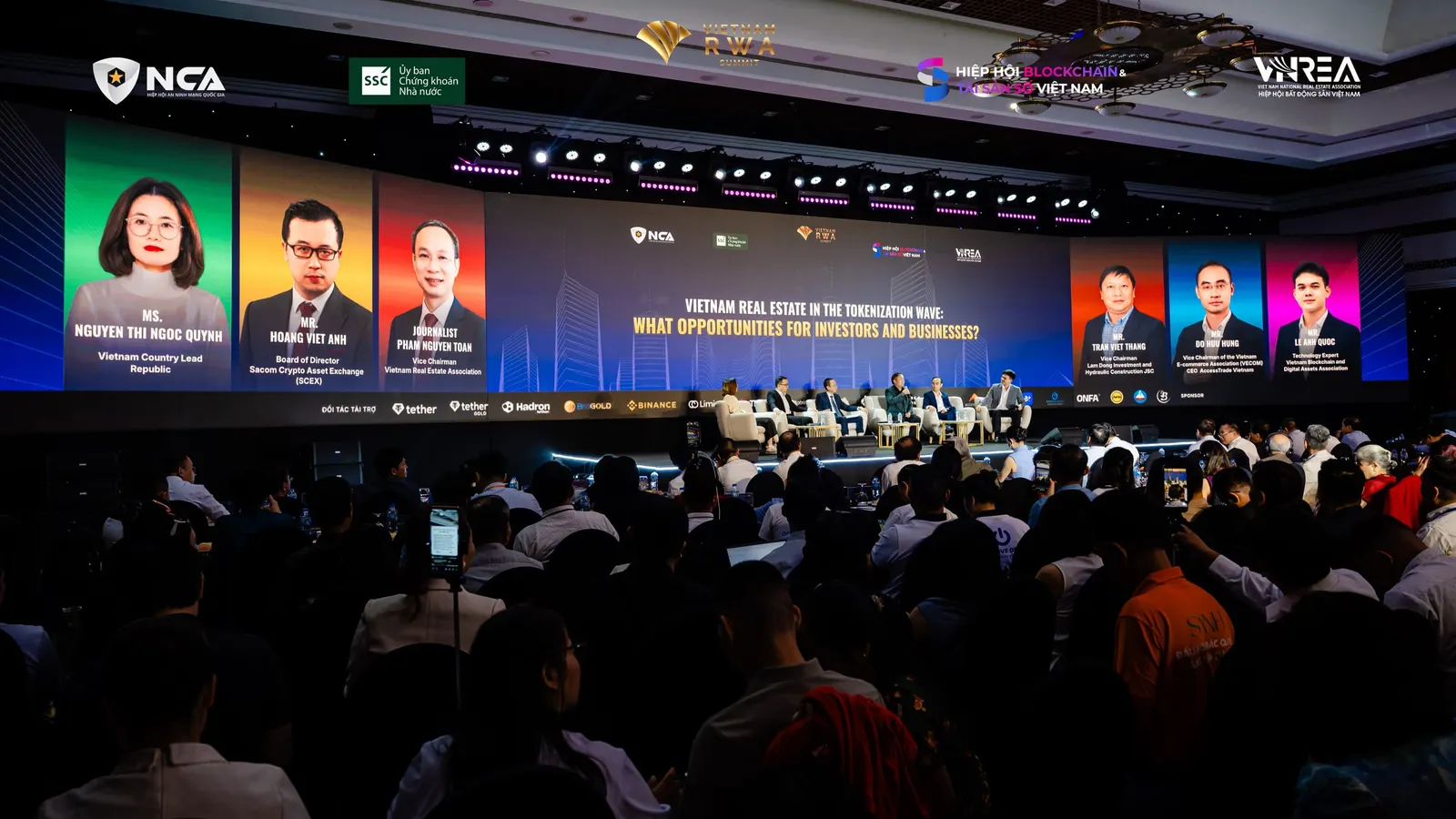
Real-world asset tokenization is a strategic lever for Vietnamese businesses to enter the global arena as designers of the rules, not merely as those who comply with and implement them. To realize this opportunity, the market needs a synchronized ecosystem in which assets, blockchain infrastructure, digital financial services, commerce and human resources develop together and connect closely with one another.
The Vietnam Real-World Asset Tokenization Summit 2026 (Vietnam RWA Summit 2026) took place on July 18–19 in Hanoi, bringing together more than 5,000 domestic and international delegates. The event focused on the conditions for forming a crypto asset and RWA market in Vietnam, from refining the institutional framework and building operating infrastructure to ensuring system safety and expanding use in the real economy.
Following Session 1 on refining the institutional framework and Session 2 on breakthrough liquidity and market safety, Session 3 was held on July 19 under the theme “Opportunities to Lead the 4.0 Economy,” shifting the focus to developing asset classes, services and applications. Real estate was placed in the role of a sector with the potential to lead the way, while connecting with blockchain infrastructure, digital financial services, e-commerce and workforce development strategy.
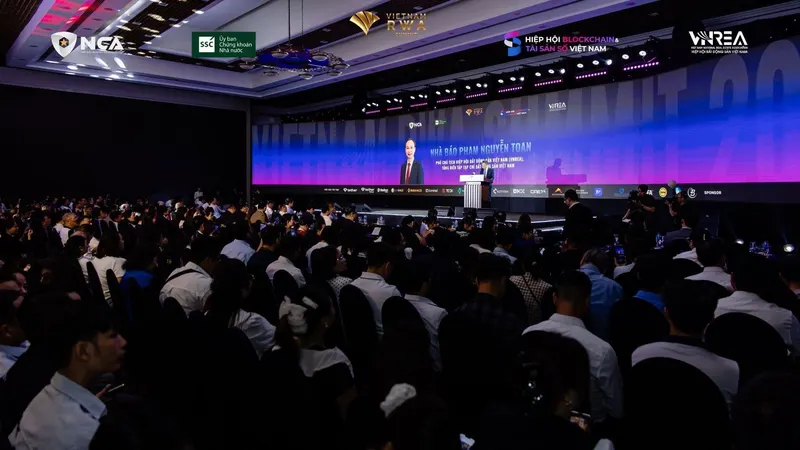
Journalist Pham Nguyen Toan, Vice Chairman of the Vietnam Real Estate Association and Editor-in-Chief of Vietnam Real Estate Magazine, delivers the opening remarks of Session 3 of Vietnam RWA Summit 2026, themed “Opportunities to Lead the 4.0 Economy,” held on July 19, 2026 in Hanoi.
Real estate leads, but it must start with assets that meet the standard
In his opening remarks, Journalist Pham Nguyen Toan, Vice Chairman of the Vietnam Real Estate Association and Editor-in-Chief of Vietnam Real Estate Magazine, stressed that real-world asset tokenization is a strategic lever for Vietnamese businesses to enter the global arena as designers of the rules, not merely as those who comply with and implement them.
“We were at a considerable disadvantage in previous industrial revolutions because of our low starting point in physical infrastructure and heavy industry. But in the digital economy, that boundary has been erased. If we master the technology in time, standardize processes and build strategic trust, Vietnam can fully become a regional digital financial center, drawing a new generation of capital flows into the economy safely and transparently,” he said.
Analyzing the combination of real estate and blockchain in depth, Mr. Toan said it is a sector with great potential for on-chain tokenization but faces three main bottlenecks: a high capital threshold for participation, low liquidity, and transaction procedures that are complex and drawn out. Tokenization therefore allows asset value to be divided into smaller units, enabling more investors to take part with capital that suits them better, which widens tradability and gives businesses another channel for accessing capital. “The essence of RWA is to completely eliminate information asymmetry, cut intermediary costs to the minimum and unlock the enormous liquidity frozen in physical assets,” Mr. Toan stressed.
However, technology can deliver results only when accompanied by a clear legal framework and mechanisms that guarantee market trust. The rights attached to tokens must be specifically defined, especially in cases of disputes, dissolution or transfer of the underlying asset. At the same time, the correspondence between real assets and tokens on the blockchain must be ensured, along with requirements for technology security, data protection and coordination among regulators, financial institutions and technology businesses. This was also a topic analyzed in depth by speakers at the session “Vietnamese Real Estate Facing the Tokenization Wave: What Opportunities for Investors and Businesses?”.
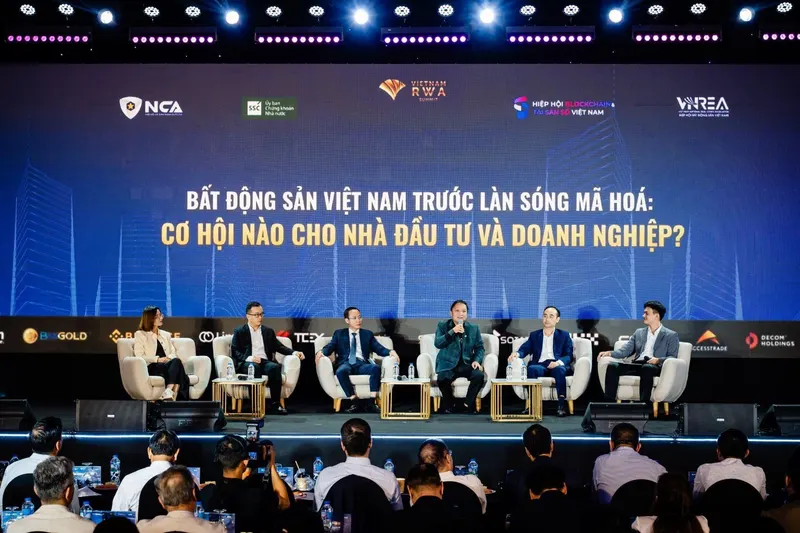
Representatives of businesses and experts at the session “Vietnamese Real Estate Facing the Tokenization Wave: What Opportunities for Investors and Businesses?”.
Ms. Nguyen Thi Ngoc Quynh, Vietnam Market Director at Republic Fintech Company, said that the value of RWA lies not mainly in splitting an asset to sell to many people, but in the ability to widen access to asset groups that were previously open only to institutions or investors with large amounts of capital. However, a product that wants to reach international capital must comply at once with Vietnamese regulations and with the standards of the market the issuer is targeting.
From the standpoint of market organization, Mr. Hoang Viet Anh, Member of the Board of Directors of Sacom Crypto Asset Exchange Joint Stock Company (SCEX), stressed that before issuing a product, it is necessary to keep clarifying how the underlying asset is handled, investors' rights and convertibility between the token and the asset behind it. Real estate in particular raises further issues, such as ownership by foreign investors and the currency used when attracting international capital. Only when the legal framework is clearer can the ability to divide and convert assets create real liquidity.
At the distribution layer, Mr. Do Huu Hung, Vice Chairman of the Vietnam E-commerce Association (VECOM) and CEO of Accesstrade, emphasized the “Product First” principle. The market needs to start with assets that already create value and cash flow and are liquid and transparent. In his view, getting the product to the right audience matters more than widening the number of people reached. In the early stage, priority should go to businesses and investors with experience in finance, securities or digital assets, and the market should expand only afterward, based on data on investor readiness.
For his part, Mr. Tran Viet Thang, Vice Chairman of the Board of Lam Dong Irrigation Investment and Construction Joint Stock Company, said that infrastructure projects need very large amounts of capital, while their benefits tend to spread across the whole economy instead of being reflected directly in the rate of return of each project. Vietnam already has the technological capability to tokenize assets transparently, but the ability to raise capital still depends on policy and on the long-term vision that investors can see.
Closing the discussion, Mr. Pham Nguyen Toan proposed a “narrow to broad” roadmap. First, pilot with existing cash-flow real estate that has been completed and is operating stably, such as office buildings, shopping centers or logistics warehouses. The market could then consider tokenizing REIT fund certificates rather than directly tokenizing land use rights or assets attached to land. During the sandbox phase, the size of assets and the range of participants should also be limited so that regulators have room to observe, assess risk and adjust policy before expanding.
Ecosystems form only when infrastructure connects to applications
Besides real estate, the crypto asset ecosystem needs many other types of assets to increase diversity and attract liquidity, while developing blockchain infrastructure, digital identity, wallets, custody, payments and supporting financial services.
At the session “Vietnam's Digital Financial Services Ecosystem: From Infrastructure Foundations to Public–Private Service Applications,” discussions ranged from the need to build national-scale blockchain infrastructure to applications that can be deployed in daily life and business operations.
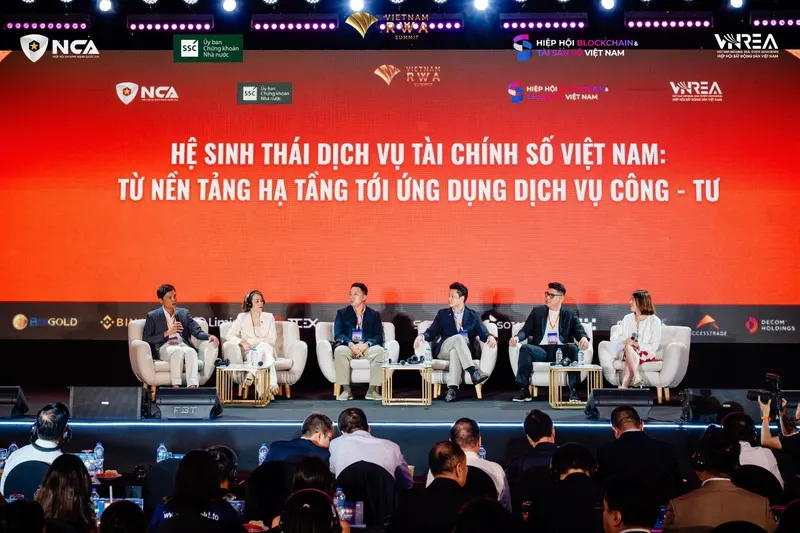
Representatives of technology and financial organizations at the session “Vietnam's Digital Financial Services Ecosystem: From Infrastructure Foundations to Public–Private Service Applications”.
According to Dr. Do Van Thuat, Director of Blockchain Solutions & Architecture at VMatrix, national-scale infrastructure must ensure data sovereignty, safety, authenticity and transparency. Rather than using a single blockchain for every purpose, shared infrastructure must develop a multi-chain architecture connected to public networks and the international ecosystem. On that foundation, goods traceability and digital identity are two groups of applications that can be deployed early.
Expanding on connectivity, Mr. Scott Lee, Country Director for Korea at Solana Foundation, said that financial institutions can start in permissioned blockchain environments to meet privacy and compliance requirements, then connect step by step to public networks. For Vietnam, he stressed the room to develop stablecoin payment infrastructure, especially for cross-border transactions, along with RWA platforms that give users access to assets that were previously hard to reach.
Meanwhile, Mr. Jeffrey Tchui, CEO and Asia-Pacific Regional Director at Hashgraph, focused on private infrastructure at international financial centers, sandbox mechanisms and interoperability among networks to support the intake of foreign investment capital.
Human resources that connect technology, law and the market
From the analysis of context and potential, along with the in-depth discussions and presentations over the two working days, the experts agreed that to connect the layers of assets, infrastructure and services, the implementation team is the core factor. Technology can be transferred and capital can be mobilized in a relatively short time, but people able to connect technology, law and business require a long and systematic training process.
This was also the focus of the session “Building a High-Quality Workforce for the Digital Economy,” where experts stressed that blockchain should be seen as a digital infrastructure layer capable of giving birth to new professions and reshaping how many existing sectors operate.
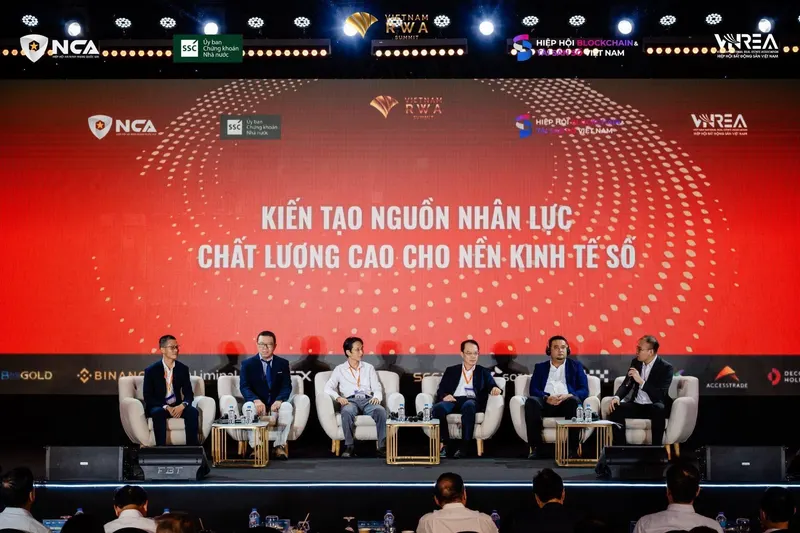
Representatives of experts, universities and businesses at the session “Building a High-Quality Workforce for the Digital Economy”.
Assoc. Prof. Dr. Tran Manh Huy, Member of the 16th National Assembly and Member of the Executive Committee of the Vietnam Blockchain and Digital Assets Association, noted that training delivers value only when accompanied by a clear legal framework. If the knowledge and models students learn have no basis for real-world deployment, the gap between training and the labor market will persist.
This gap is all the more evident because curricula are usually updated more slowly than technology practice. According to Mr. Huy, schools need to work with businesses on curriculum design, update content and bring practicing experts into teaching. However, current restrictions on the qualifications of instructors remain a bottleneck in coordination among the State, schools and businesses.
This makes interdisciplinary training urgent. Assoc. Prof. Dr. Ngo Quoc Chien, Deputy Dean of the Faculty of Law at Foreign Trade University, said that learners still need a core professional foundation and then add knowledge from related fields. The important change lies not in adding a few technology courses to the curriculum, but in shifting from imparting knowledge to training the ability to recognize and solve problems in a digital context, where technology, economics and law are increasingly intertwined.
Mr. Pham Van Huong, Head of the Faculty of Information Technology at the Academy of Cryptography Techniques, proposed that training start from real-world problems and then proceed from exploitation and application to improvement and mastery of core technology. For blockchain, this process must be tied to cryptography, information security, tracing, multi-chain and new research directions such as post-quantum cryptography. This approach lets learners not only know how to use the technology but also evaluate and ensure the safety of the entire system.
Vietnam's opportunity lies not only in tokenizing more assets, but in the ability to build an ecosystem with assets that meet the standard, suitable infrastructure, diverse services and a team capable of delivering. When these components develop in sync, crypto assets and RWA can become part of the process of mobilizing resources, renewing business models and raising the competitiveness of the digital economy.
The event also drew the participation of Assoc. Prof. Dr. Phan Thanh Duc, Dean of the Faculty of Information Technology and Digital Economy at the Banking Academy of Vietnam; Mr. Hairil Izwan Bin Isamuddin, Regional Director for Southeast Asia at CompTIA; Mr. Nathan Ho, Founder and CEO of Onfa Fintech USA; Mr. Danchen Huang, Director of Institutional Cooperation at Antalpha RWAHub; Ms. Maria Phan, Chairwoman of the Board of OpenLive Group and Founder of the OBranding e-commerce platform; and Dr. Nguyen Ha Bang, CEO of the OBranding e-commerce platform, among others, together with experts, regulators and business representatives in Web3, digital finance, e-commerce and workforce training.
Vietnam Real-World Asset Tokenization Summit 2026: The Meeting Point for Vietnam's Digital Assets Vietnam RWA Summit 2026 is a multilateral dialogue forum on policy and market practice, focused on identifying the key institutional, infrastructure and implementation-capacity conditions needed to advance the digital asset market. In doing so, the event helps expand opportunities for Vietnam to become a new destination for capital, technology and digital finance models in the region. The summit comprises three working sessions over two days, July 18–19, 2026. Session 1 discussed the legal framework for crypto assets and RWA, risk management, anti-money laundering, cybersecurity and public–private coordination. Session 2 focused on tokenization solutions, multilateral cooperation to expand RWA liquidity, the readiness of enterprises and investors, and the requirements for ensuring digital asset safety. Session 3 focused on the tokenized real estate market, Web3 infrastructure, the digital financial services ecosystem, blockchain applications in commerce and workforce development. The summit was supported by major partners in Vietnam and abroad, including Tether, Binance, BIGOD, OpenLive, OKX, ONFA Fintech USA, Liminal Custody, Aifin Technologies Holdings, SotaTek, Techcom Crypto Asset Exchange (TCEX), Vietnam Thinh Vuong Crypto Asset Exchange (CAEX), Lam Dong Irrigation Construction Company, Sacom Crypto Asset Exchange (SCEX), Polaris Holdings and AccessTrade. |