


Ensuring data sovereignty, balancing the interests of businesses and state regulators who take part in deployment, and running one effective tracing system for anti-money laundering are essential requirements of the secure blockchain infrastructure VBSN is working toward, stressed Mr. Phan Duc Trung, Chairman of VBA and Chairman of VMatrix.
On December 9, 2025, the workshop "Shaping Vietnam's Blockchain Ecosystem from Secure Digital Infrastructure" was held in Hanoi, organized by the Vietnam Blockchain and Digital Assets Association (VBA) in coordination with VMatrix, True IDC and Tether. It brought together technology, finance and data experts to share an overall picture of blockchain infrastructure at a time of rising global digital asset risks.
The event focused on the capacity to operate secure infrastructure, scalability, and international standards for security and on-chain monitoring, with the aim of building secure infrastructure for Vietnam's blockchain ecosystem.
Three Pillars of Secure Blockchain Infrastructure
In his opening remarks, Mr. Phan Duc Trung, Chairman of VBA and Chairman of VMatrix, stressed that blockchain is one of the nation's strategic technologies and contributes directly to the breakthrough goals for science, technology, innovation and digital transformation under Politburo Resolution No. 57-NQ/TW.
According to Mr. Trung, developing blockchain infrastructure requires a balance. National sovereignty must be ensured by storing highly sensitive data in licensed domestic data centers, while performance and scalability are optimized through foreign cloud services. In addition, deploying an effective tracing system that meets anti-money laundering and countering the financing of terrorism (AML/CFT) requirements is mandatory for secure blockchain infrastructure. "These are also the goals the Vietnam Multi-Blockchain Service Network (VBSN) is working toward to build a sustainable Vietnamese blockchain ecosystem," Mr. Phan Duc Trung stressed.

Mr. Phan Duc Trung, Chairman of VBA and Chairman of VMatrix, stresses that secure infrastructure is the foundation for a sustainable Vietnamese blockchain ecosystem.
Speaking on physical data infrastructure, the first element of the overall blockchain infrastructure, Mr. Nguyen Dinh Hung, CEO of True IDC Viet Nam, said demand for cloud infrastructure is rising sharply as big data, AI and blockchain are deployed widely. The public cloud market in Asia is expected to exceed USD 200 billion in 2025, with annual growth of 19.32% over 2025-2029. In Vietnam, the market is forecast to grow by an average of 25.24% per year. About 70-80% of the nodes of major blockchains run on public cloud. On-chain activity in the Asia-Pacific (APAC) region rose 69% year on year by June 2025, making the cloud the default platform for the modern blockchain model.
Mr. Hung stressed that, as an AWS partner in Vietnam, True IDC is committed to helping businesses test performance, stability, security and scalability before official deployment. It also advises on design, and on optimizing costs, operating processes and monitoring, throughout the cloud's life cycle.
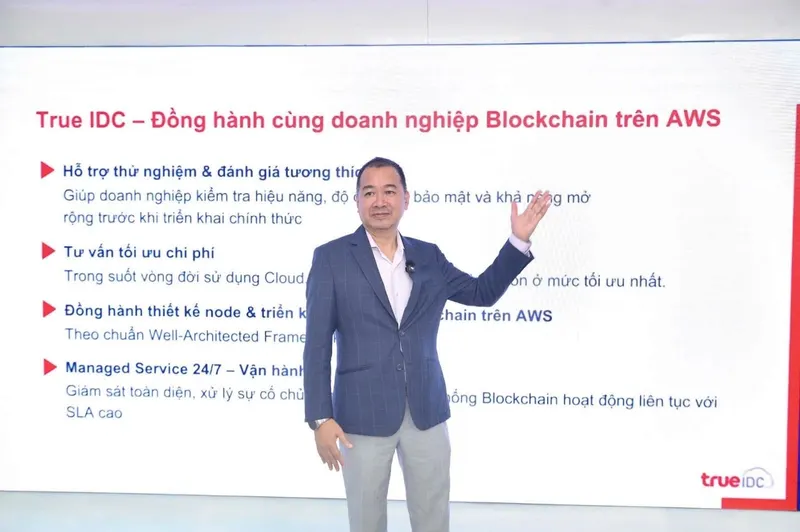
Mr. Nguyen Dinh Hung, CEO of True IDC Viet Nam, speaks about cloud infrastructure demand as data and blockchain expand.
On the technical side, Mr. Nguyen Trung Kien, Solutions Architect at True IDC Viet Nam, analyzed AWS security capabilities: more than 850 virtual server types, 38 regions, 120 availability zones, and more than 300 security and compliance services. In particular, the Nitro and Nitro Enclaves technologies fully isolate data-processing workflows, block all unauthorized access and generate tamper-proof security attestations through cryptographic encryption. For blockchain businesses, these features provide the defensive layer that nodes, wallets, smart contracts and sensitive data need.
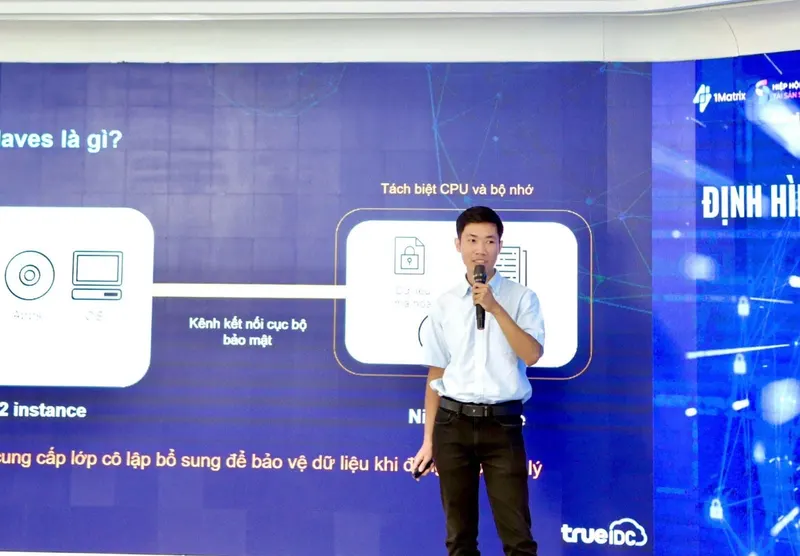
Mr. Nguyen Trung Kien presents the security capabilities of AWS infrastructure.
VBSN: Multi-Chain Service Infrastructure for Vietnam's Blockchain Ecosystem
To address the major infrastructure challenge and fulfill the commitment made to General Secretary To Lam at the 6th National Forum on Digital Technology Enterprise Development, the Vietnam Multi-Blockchain Service Network (VBSN) was designed by VMatrix with advice from BCG and VBA. With a 5-tier, multi-chain architecture optimized for scalability, security and interoperability, VBSN can meet long-term digitalization needs. It lets businesses develop applications without re-investing in infrastructure, while giving state regulators greater capacity for transparent management and supervision.
In particular, VBSN allows multiple independent Layer 1 networks to be deployed, with the consensus algorithm and processing speed tailored to the needs of each application group. This multi-chain structure separates loads, reduces network congestion and maintains stability when handling large transaction volumes.
According to Mr. Tran Trung Hieu, Senior Infrastructure Manager at VMatrix, VBSN serves three key roles. First, it ensures interoperability among many applications, from identity and digital finance to sector-specific data, through a standardized interoperability layer. Second, it meets speed requirements, targeting the processing of millions of transactions per second. Third, it complies with modern security standards and supports independent monitoring and verification mechanisms to limit fraud, while meeting the standards of the Data Law of 2024, the Personal Data Protection Law of 2025, the global information security standard ISO/IEC 27001 and the ISO/IEC 27701 privacy standard.

Mr. Tran Trung Hieu, Senior Infrastructure Manager at VMatrix, sets out VBSN's direction on interoperability, processing speed and security-standard compliance.
On-Chain Tracing Helps Shape Secure Digital Infrastructure
To clarify the challenges and solutions in building Vietnam's blockchain ecosystem, the panel "Reshaping Vietnam's Blockchain Ecosystem from Secure Digital Infrastructure" featured Mr. Tran Huyen Dinh, Chair of the VBA Fintech Application Committee; Mr. Nguyen Dinh Hung, CEO of True IDC Viet Nam; Dr. Do Van Thuat, Director of Blockchain Solutions & Architecture at VMatrix; Mr. Nguyen Trung Kien, Solutions Architect at True IDC Viet Nam; and Mr. Navin Gupta, CEO of Crystal Intelligence.

(Left to right) Mr. Nguyen Trung Kien (True IDC Viet Nam), Mr. Navin Gupta (Crystal Intelligence), Mr. Nguyen Dinh Hung (True IDC Viet Nam), Mr. Do Van Thuat (VMatrix) and Mr. Tran Huyen Dinh (VBA) take part in the discussion "Reshaping Vietnam's Blockchain Ecosystem from Secure Digital Infrastructure".
The discussion analyzed how to balance data sovereignty with performance requirements as Vietnam accelerates large-scale cloud deployment; the role of international certifications in setting up a secure environment for running blockchain nodes; and how blockchain can be turned into real economic value for businesses through standardized service tiers. The speakers also discussed the prospects of applying blockchain to public services, especially in areas that need data provenance verification and real-time on-chain monitoring of transactions, contributing positively to the growth of the digital economy.
According to Mr. Maksym Dragunov, Director of Policy and Advisory at Crystal Intelligence, a global Web3 data analytics company, its systems are tracking more than 105,000 labeled wallet addresses, have recorded more than 11 million risky transactions and monitor more than 3,800 types of digital assets.

Mr. Maksym Dragunov, Director of Policy and Advisory at Crystal Intelligence, warns of the growing use of wallet address spoofing and of abuse of digital asset bridges.
Mr. Dragunov said that fraud such as address poisoning, which creates fake wallet addresses whose first or last characters match a real address to deceive users, or exploits custom wallet addresses to cause confusion, is creating major challenges for the authorities. Criminals also abuse bridges that move assets between blockchains, along with instant exchange services, to erase their tracks, making tracing difficult. He advised businesses and individuals to keep a whitelist of safe wallet addresses, check every character carefully before sending funds, and use automated risk-alert tools to protect their assets.
The experts also stressed the need to build and deploy a comprehensive on-chain tracing system. Such a system not only supports transaction monitoring but also plays a key role in detecting, preventing and reducing money laundering, terrorist financing and increasingly sophisticated abuse of crypto assets. It helps regulators control risk proactively and creates a safer environment for investors in the Web3 sector.