

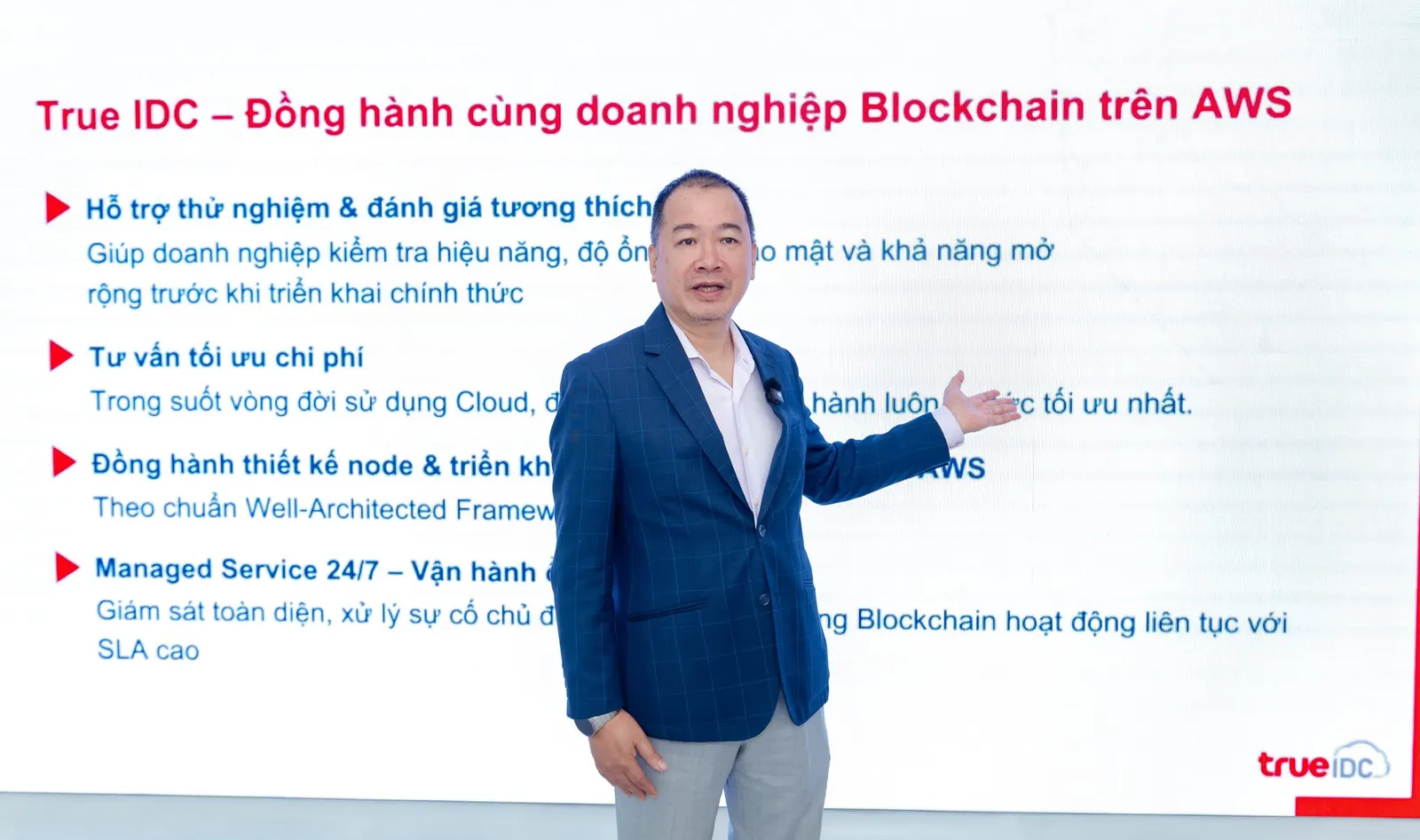
Investment in cloud, data centers and digital infrastructure will determine the speed, scale and quality of blockchain deployment in businesses and nations. It is the key for Vietnam to keep pace with global technology trends, achieve its goals of a digital nation and international integration, and establish Vietnam's firm sovereignty in the global digital space.
The “backbone” of the blockchain ecosystem
A blockchain ecosystem is a complex structure comprising technology platforms, applications, user communities and supporting infrastructure. Within it, technology infrastructure serves as the “backbone,” ensuring distribution, security and performance across the whole system.
A strong blockchain network depends not only on algorithms but also on its ability to connect, store and process data, through key components: cloud, data centers, digital infrastructure and blockchain infrastructure.
Cloud offers flexible scalability, lowers upfront investment and supports rapid deployment of blockchain applications. Blockchain-as-a-Service (BaaS) offerings such as AWS, Azure or TrueIDC Cloud let businesses test and deploy proofs of concept (PoC) without heavy hardware investment. This is key to driving innovation and lowering barriers to entry.
In addition, following the issuance of the Politburo's Resolution No. 57-NQ/TW dated December 22, 2024, on breakthroughs in science, technology, innovation and national digital transformation, leading Vietnamese telecommunications and information technology companies such as Viettel, FPT and CMC have been working to develop their own “Make in Vietnam” cloud platforms to assert Vietnam's sovereignty in the global digital space. Although a gap in features and technology remains compared with the global platforms above, domestic cloud is expected to gain a firm footing within the next 5–7 years in Vietnam, especially for domestic applications.
The second element is the data center, where the huge volume of blockchain transactions is stored and processed. Tier III-certified centers with redundancy, encryption and strong security ensure stability, low latency and data safety. This is a prerequisite for blockchain to operate continuously and reliably. Today this service is provided by domestic providers, the leading telecommunications and IT companies such as Viettel, FPT, VNPT and CMC, which together hold 90% of the market in Vietnam.
Third, digital infrastructure, including broadband telecommunications, 5G and IoT, is the “backbone” connecting blockchain nodes. Transmission speed and network stability directly affect blockchain performance, particularly in applications requiring real-time transaction processing such as finance and logistics. Vietnam's digital infrastructure is a point of pride: internet access speed and penetration in Vietnam are on par with other countries in the Asia-Pacific region. This is an important foundation for the development and integration of blockchain technology in Vietnam. We stand on equal footing with any digital infrastructure in the region.
Fourth, blockchain infrastructure comprises private blockchain platforms (consortium or private) that let businesses control data and ensure legal compliance and security. This is a popular choice in industries with high security requirements, such as banking and insurance. However, Vietnam needs a national blockchain platform. This would be a shared platform that lets developers of diverse application layers deploy quickly and bring a diverse ecosystem of blockchain applications to market, without having to build their own chains unprofessionally and at risk to stable operation, security and compliance commitments.
In Vietnam, VBSN is a “Make in Vietnam” blockchain platform with the scale and quality of a national-level platform at this time.

According to Mr. Nguyen Dinh Hung, for blockchain to become a new growth driver, Vietnam needs an integrated investment strategy in digital infrastructure, stronger public-private cooperation and specialized training in blockchain and infrastructure technology.
Strategic impact: from infrastructure to practical value
Systematic investment in infrastructure does not merely solve technical problems; it also creates powerful synergies. Strong infrastructure allows blockchain to be integrated with AI, big data and IoT, producing smart solutions for many sectors. Cloud and BaaS help businesses quickly deploy applications such as traceability and smart contracts. Encryption, network security and international standards help reduce the risk of cyberattacks.
Vietnam is accelerating the development of integrated digital infrastructure, including 5G networks, national data centers and cloud computing, to support new technologies such as blockchain and AI. Providers such as True IDC, CMC, Viettel, VNPT and FPT are investing heavily in data centers and cloud to meet business demand. In practice, many traceability and digital payment projects have been deployed on blockchain combined with cloud, demonstrating the strategic role of technology infrastructure.
However, many bottlenecks remain to be resolved on the road ahead. The challenges lie in high investment costs, demanding security standards and a shortage of quality personnel. In particular, public awareness of blockchain technology remains limited, clouded by stereotyping that associates this advanced technology with its negative aspects.
For blockchain to become a new growth driver, an integrated investment strategy in digital infrastructure is needed, along with stronger public-private cooperation and specialized training in blockchain and infrastructure technology. The State should consider tax incentives for blockchain businesses for at least the next 10–20 years, to accompany and encourage technology talent and entrepreneurs to make strong, long-term investment commitments to this ecosystem. Alongside this, communication and promotion of blockchain technology to the public should be stepped up.