

A transparent digital asset market needs the participation of all parties. Investors need to equip themselves with sufficient knowledge and skills before entering the market. Exchanges need to build transparent operating processes with tight controls from the start. Regulators need to play an active role in prevention and in going after crime in Web3 assets.
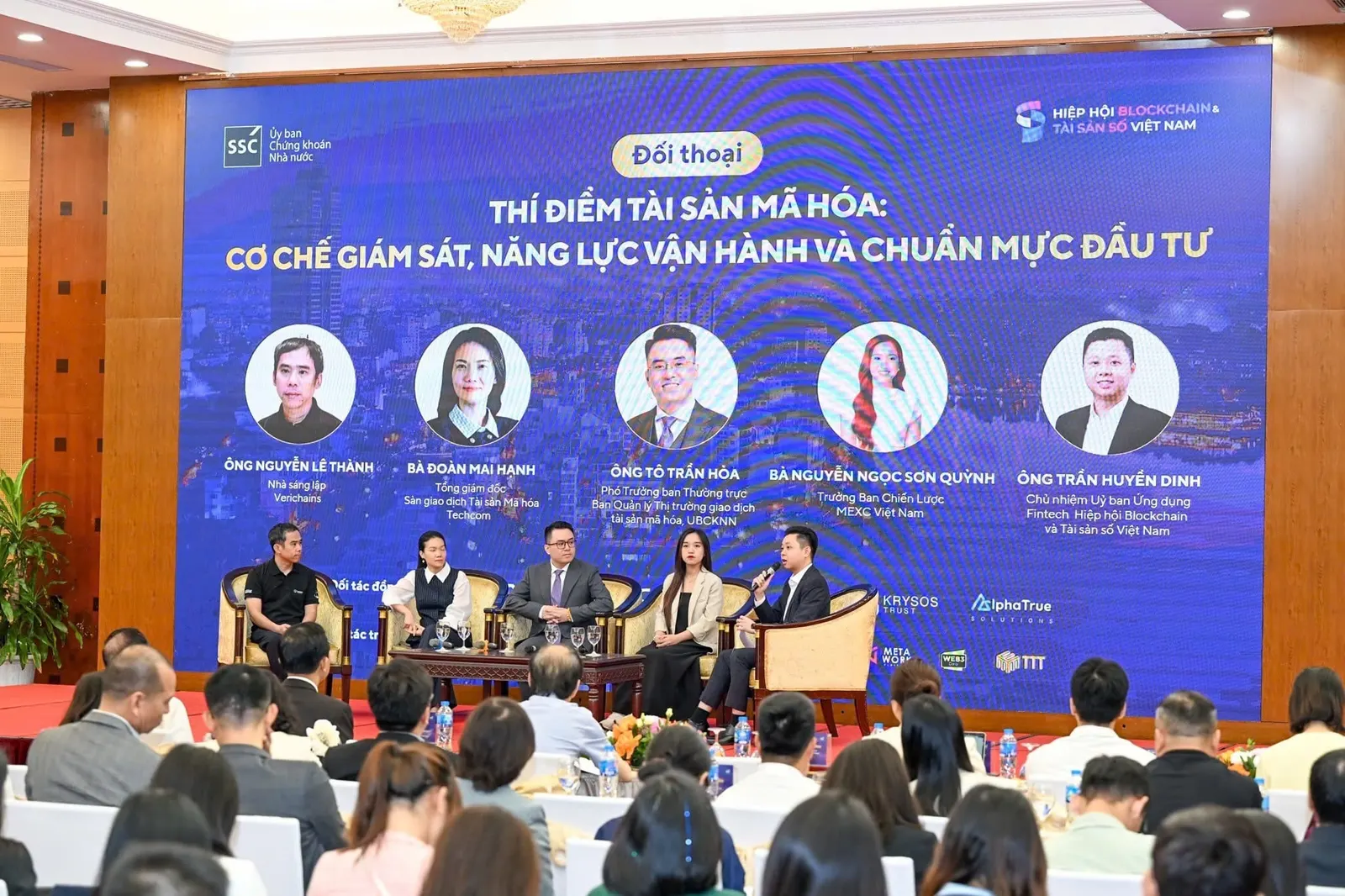
On the morning of March 25, 2026, the State Securities Commission (SSC) under the Ministry of Finance, in cooperation with the Vietnam Blockchain and Digital Assets Association (VBA), held the dialogue "Piloting Digital Asset Exchanges: Oversight Mechanisms, Operational Capacity and Investment Standards." Hundreds of guests attended, including representatives of regulators such as the Ministry of Finance, the Ministry of Public Security, the Ministry of Justice and the State Bank of Vietnam, as well as crypto asset companies, technology firms, banks, financial institutions and the investor community.
In his opening remarks, Mr. Phan Duc Trung, Chairman of VBA, said this is an open forum for regulators to hear about real conditions, helping to refine the subordinate regulations and implementation guidance for the Law on Digital Technology Industry and Resolution 05/2025/NQ-CP on piloting the crypto asset market. The dialogue is also a "playground" for exchanges that have applied for licenses to find customers and partners offering services and solutions. Exchanges and large, well-known organizations worldwide are also eagerly awaiting concrete decisions, information and steps from Vietnam so they can enter this market, which is worth more than USD 200 billion.
"VBA has always held firm to its position as a bridge, listening to and conveying the messages of investors, international exchanges and Web3 market developers to regulators," Mr. Trung said.
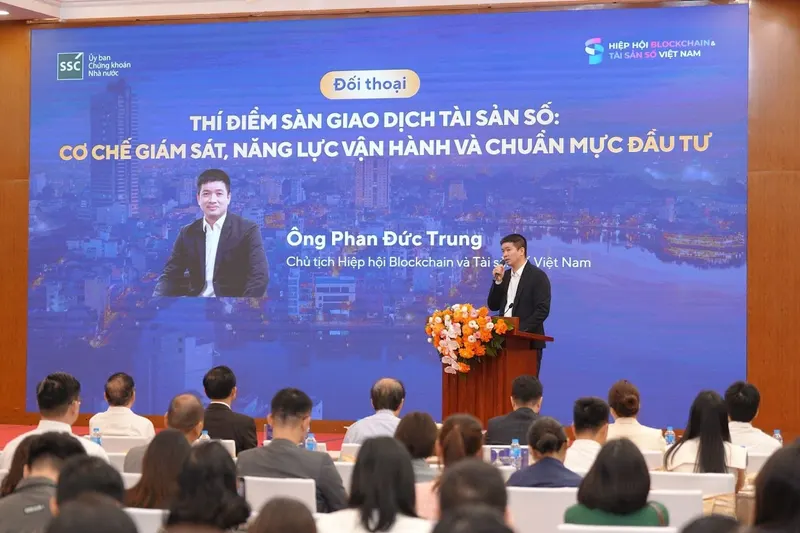
Mr. Phan Duc Trung, Chairman of VBA, affirmed that VBA is always a multilateral information bridge between state regulators, businesses and the community.
Drawing on the real-world fight against crimes involving crypto assets, Colonel Hoang Ngoc Bach, Head of Division 4 at the Department of Cybersecurity and High-Tech Crime Prevention (A05), Ministry of Public Security, said that the lack of legal provisions makes investigations difficult not only at the tracing stage: even when leads are found, they are hard to act on because the money flows all pass through foreign exchanges.
"Mainstream exchanges will help reduce violations of the law, strengthen the capacity to prevent money laundering and terrorist financing, and bring Vietnam off the FATF grey list," Colonel Bach emphasized.
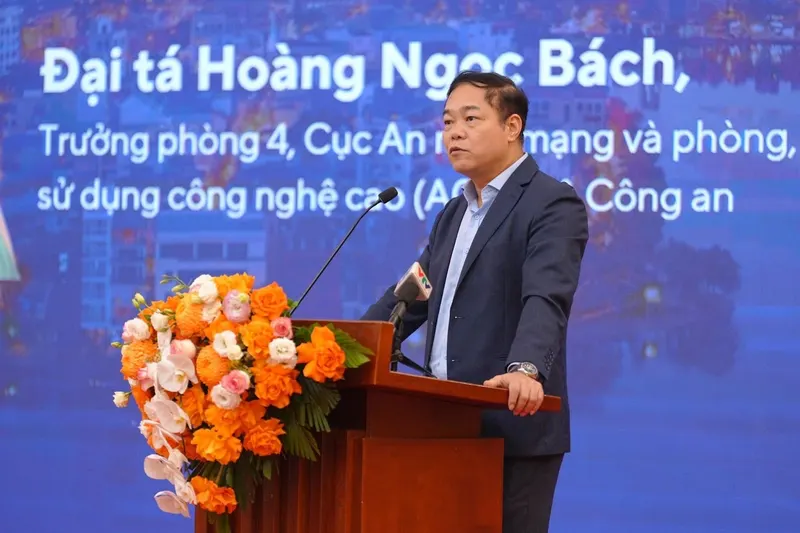
Colonel Hoang Ngoc Bach, Head of Division 4, Department of Cybersecurity and High-Tech Crime Prevention (A05), Ministry of Public Security, speaks at the Dialogue on piloting crypto asset exchanges.
A transparent crypto asset market needs the participation of all parties. Colonel Bach recommended that investors equip themselves with sufficient knowledge and skills. Exchanges need to build transparent operating processes with tight controls, starting from user identity, monitoring of unusual transactions and stronger coordination between regulators and law enforcement. Regulators need to complete the legal rules on managing transactions and act proactively to prevent and handle those who exploit crypto assets for profit.
Digital asset pilot licensing: a test of people, technology and transparency
In the public-private dialogue on the crypto asset pilot, the issue of post-licensing supervision was raised head-on. Mr. To Tran Hoa, Standing Deputy Head of the Crypto Asset Trading Market Management Board (SSC), said that beyond statutory conditions such as charter capital or shareholder structure, the Management Board will focus on assessing companies' real operating capacity, including the quality of their technology systems, the experience of their teams and the degree of transparency in their operations.
"This is a new market with many latent risks, so regulators are taking a cautious, step-by-step approach. In the first phase, only domestic investors who already hold crypto assets, and foreign investors, are allowed to trade on Vietnamese exchanges. A key additional task in the coming period will be programs to build investor knowledge, which the SSC will run together with units such as the Ministry of Public Security, the State Bank of Vietnam and VBA," Mr. To Tran Hoa emphasized.
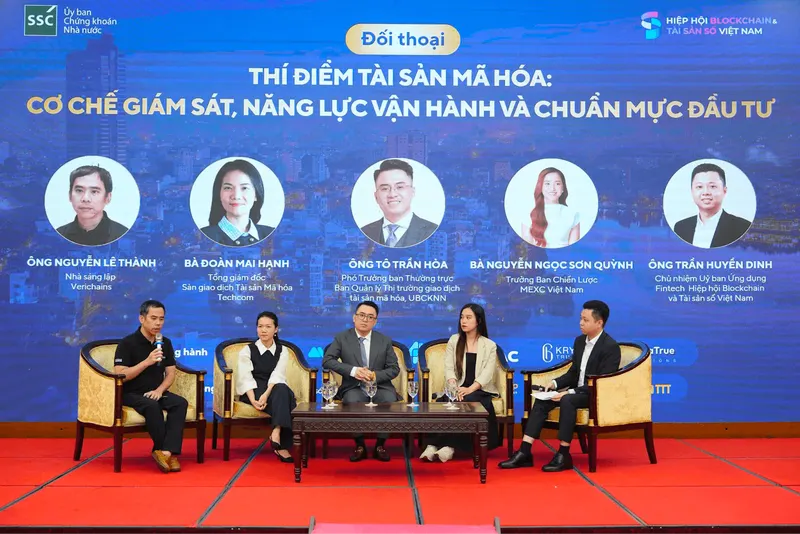
(From left to right) Mr. Nguyen Le Thanh (Verichains), Ms. Doan Mai Hanh (TCEX), Mr. To Tran Hoa (SSC), Ms. Nguyen Ngoc Son Quynh (MEXC Vietnam) and Mr. Tran Huyen Dinh (VBA) discuss the pilot of crypto asset exchanges.
One important principle the experts stressed is separating customer assets from the exchange's own assets. This is seen as the foundation for protecting investors in every scenario, even if an exchange stops operating. In parallel, regulators are also building response scenarios for market risk, including an early warning mechanism and a way for investors to act on their assets in unusual situations.
From a technical standpoint, Mr. Nguyen Le Thanh, Founder of Verichains, said that requiring Level 4 information system security for crypto asset exchanges, higher than the usual requirement (stock exchanges currently require Level 3), is necessary. System security does not stop at obtaining a certification; it is a continuous operating process that requires real-time monitoring, periodic testing and rapid response to incidents.
The biggest risk comes not from external attacks but from internal systems and the connection points between the blockchain environment and the exchange's operating infrastructure. According to Mr. Thanh, these are sensitive areas where assets move and that often become targets of sophisticated attacks.
One of the candidate pilot exchanges, Ms. Doan Mai Hanh, CEO of Techcom Crypto Asset Exchange Joint Stock Company (TCEX), said the biggest challenge in the preparation phase lies not only in technology but also in people.
"The market currently lacks personnel who can combine financial knowledge with blockchain technology, yet this is a core requirement for safe and compliant operation. TCEX is actively building a core team of more than 50 people. We have also taken the initiative to master exchange technology after many years of research, refined our operating processes and internal testing, and are ready to deploy as soon as the legal framework allows. TCEX's system can handle up to about 100,000 transactions per second, can scale with market demand and meets Level 4 information security requirements, while we work with reputable partners on custody, security and on-chain transaction analytics solutions," Ms. Hanh said.
Drawing on international experience, Ms. Nguyen Ngoc Son Quynh, Head of Strategy at MEXC Vietnam, said domestic exchanges need to invest properly in their systems from the start. The digital asset investor community today is no longer new: it is experienced and has very high expectations for processing speed, asset safety, KYC data security, AML systems and risk management capability in both technology and people.
The challenge of trust and customer experience
If the question of the first discussion session was "How do we operate correctly?", the second session, "Strategies for Attracting Investors to Exchanges in the Early Stage," focused on an equally important problem: how to gain real users in a market already used to international exchanges.

(From left to right) Ms. Do Thi Thu Ha (VMatrix), Mr. Hoang Quang Minh (Web3 marketing expert), Ms. Le Vu Huong Quynh (Tether) and Mr. Le Sy Nguyen (Bitget Vietnam) discuss strategies for attracting investors to domestic exchanges in the early stage.
According to Mr. Le Sy Nguyen, Director of Bitget Vietnam, the factors that keep Vietnamese investors trading on a domestic digital asset exchange include liquidity, an optimized user experience, a diverse product range and assured safety. The system must run stably from the first days of operation. Even a small technical incident can quickly "erode" trust, and restoring credibility then takes far longer.
Around the world, many crypto asset exchange models have succeeded. Ms. Le Vu Huong Quynh, APAC Director of Regional Development at Tether Financial Technology Group, cited the example of PDAX in the Philippines. Beyond offering crypto asset trading (wallets, liquidity provision, foreign currency exchange, crypto asset services and more), the exchange also attracts international investors by providing remittance services worth about USD 40 billion a year.
Meanwhile, Mr. Hoang Quang Minh, a Web3 marketing expert, said Vietnamese exchanges can learn from those that came before but do not need to become a version of global platforms. "Domestic exchanges need to position themselves as the best fit for domestic users, drawing on their advantages in understanding the market, their connections to the banking system and the legal framework in Vietnam," Mr. Minh emphasized.