

A Dan Tri reporter spoke with Mr. Phan Duc Trung, Chairman of the Vietnam Blockchain and Digital Assets Association (VBA) and Chairman of VMatrix, to decode the digital asset market in the new era.
Da Nang as a “Laboratory” and the Challenge of Attracting Foreign Currency
The Government has just requested that the scheme for piloting digital asset exchanges be finalized under Resolution No. 05/2025/NQ-CP on piloting the crypto asset market. How do you assess the timing of this decision for Vietnam's effort to become a “destination” for technology capital in 2026?
- I think this is a particularly important step for Vietnam. In fact, since the Politburo issued Resolution No. 57-NQ/TW, we have seen a clear change in legal direction. Da Nang's licensing of a sandbox (controlled testing) that allows crypto asset transactions, especially USDT, to be converted into VND is not just a technology experiment but a recognition of real market demand.
Da Nang is applying the National Assembly's Resolution No. 136/2024/QH15 on the organization of urban government and the piloting of a number of special mechanisms and policies, to realize its ambition of becoming an international financial center. Piloting digital asset solutions through start-ups such as Basal Pay is a pioneering step under close supervision.
These are models for converting crypto assets into VND from the perspective of supporting innovative startups. The National Assembly has also allowed Da Nang to expand the scope of testing citywide rather than limiting it to a few specific locations.
Why is expanding the sandbox scope citywide considered an important step?
- When it is done only at small, narrow sites, we see only the purely technological side. When it is expanded citywide, we begin to see the real economic impact. This mechanism is comparable to what Thailand is doing in Phuket or Switzerland in Lugano and Zug. Imagine international tourists holding crypto assets who can easily convert them to pay at restaurants or buy a SIM card in Vietnam. This is in essence a very large source of foreign currency revenue, similar to remittances. Remittances bring Vietnam USD 16–20 billion a year, and crypto assets could well contribute to that figure if we take a more open view.

Mr. Phan Duc Trung, Chairman of the Vietnam Blockchain and Digital Assets Association (VBA) and Chairman of VMatrix.
Real-World Asset Tokenization and the “Fish Market Paradox”
The world is talking about the trend of real-world asset (RWA) tokenization, which could account for 10% of global GDP by 2033. How do you see the opportunity for Vietnam's traditional capital market in this trend?
- RWA is a global trend, but from a regulatory standpoint we have to perfect both institutions and technology. I often give this example: it is like having a traditional “fish market” that sells dried goods. Now we want to build a new fresh-seafood market with precise cold-storage standards. The problem is how to let the fish still be traded in the old market without creating irrational price gaps or high risk.
Vietnam still has a gap in technology standards on traditional exchanges, such as stock exchanges, to accommodate digital assets. For example, if we boldly listed a Bitcoin ETF to trade as on the exchanges of Thailand, Hong Kong or the United States, the technology test would be very clear.
The second important point is that when tokenizing real assets to attract capital, we need to handle the current account very skillfully. Capital flows through crypto (digital assets) come in and out very quickly; if we cannot find reasons for them to stay long term, it will put tremendous pressure on the exchange rate.
So in early 2026, which types of digital assets can we expect to produce a breakout?
- I predict that early 2026 will not see many “explosive” breakouts unless the Government strongly promotes attracting foreign currency through RWA. At present, policy remains very cautious: the State does not allow RWA to be traded in foreign currency; it must be converted to Vietnamese dong so that the State Bank of Vietnam can manage the exchange rate.
In my view, RWA should initially target highly reputable assets such as government bonds, US dollars or USD-denominated corporate bonds. We need to create a standard concept so that people understand what RWA is, and clearly distinguish its liquidity and risk from those of traditional securities. At present, Vietnamese people still do not have full access to these assets on domestic exchanges, even though they are trading very actively on international exchanges such as Binance.
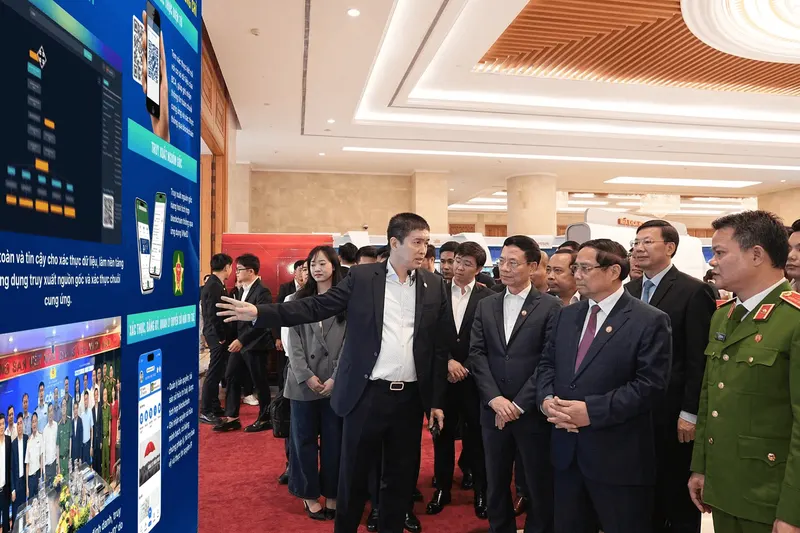
At the Government Office, Mr. Phan Duc Trung presenting the latest results of the VBSN network to State leaders.
For Sustainable Development of the Crypto Asset Market
For the crypto asset market to develop sustainably, what are the key principles in risk management and investor protection?
- There are only two core principles: a legal framework and the classification of risk “appetite.” In Vietnam, institutions currently classify only by “benefit appetite” – that is, VIP customers get higher returns – but pay little attention to classifying “risk appetite.” Investors enter without knowing what risk threshold they are at, leading to confusion between savings deposits and high-risk investment assets. In addition, the community needs to equip itself with the knowledge to allocate a sensible portfolio among gold, land and digital assets.
How has VBA coordinated with regulators to help make the market more transparent?
- We are working closely with law enforcement agencies through the program to trace suspicious projects, ChainTracer. By our assessment, as much as 80–90% of the innovative startup market previously had legal problems. Many projects raised millions of dollars but used multi-level structures or promised profits and then disappeared.
Strong involvement by regulators helps stabilize a market that has been losing trust. Handling violations is a process of consolidation. We need to move from “gray area” transactions to a transparent system in which administrative, civil and criminal violations are clearly delineated.
I hope that in 2026 we will see high-tech joint ventures, where traditional industries apply blockchain to digitize their business environment. Blockchain will appear quietly but effectively in traceability, transparent document processing, or even in helping relieve congestion in centralized public services with large numbers of users such as VNeID.
For investors, the most important message the Association wants to convey is: equip yourself with knowledge. Never rely entirely on any legal framework or market to help you make money; success or failure lies in the investor's own knowledge.