

To realize the potential of an RWA market worth up to 10% of global GDP, estimated at USD 19 trillion by 2033, risk management across all three dimensions is the top priority: underlying asset and legal ownership risk, financial structure risk and technology risk.
RWA: From Investment Opportunity to Global Digital Finance Trend
On April 7, 2026, the Vietnam Blockchain and Digital Assets Association (VBA) held the workshop “Real-World Asset (RWA) Tokenization Solutions: Balancing Benefits and Risk Management for Investors,” bringing together nearly 100 legal, financial and technology experts from Vietnam and abroad.
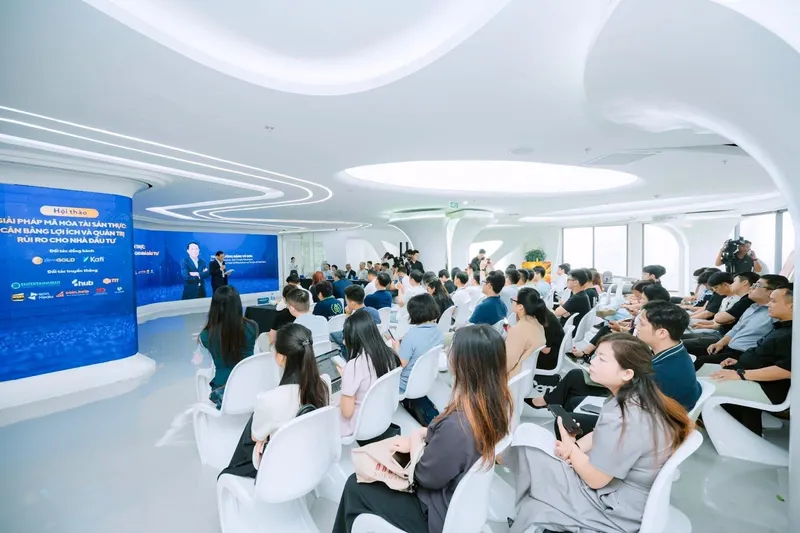
Experts in finance and blockchain technology, together with representatives of many businesses and organizations, attended the program, with nearly 100 delegates attending in person.
The workshop took place as Vietnam prepares to pilot crypto asset exchanges under Resolution No. 05/2025/NQ-CP of the Prime Minister. This calls for an operating framework for the asset groups expected to be traded, especially tokenized real-world assets (RWA).
In his opening remarks, Lieutenant General Dang Vu Son, Former Head of the Government Cipher Committee and Senior Advisor to the Vietnam Blockchain and Digital Assets Association, said that if designed correctly, crypto assets can do more than open a new investment channel. They can also become digital trust infrastructure for the economy in the digital era.
“Vietnam's greatest opportunity is not just to move fast, but to get it right from the start. As global capital markets restructure sharply under the impact of blockchain technology, a systematic approach to institutions, standards and governance will determine how deeply Vietnam can take part in the new digital financial architecture,” Lieutenant General Son stressed.

Lieutenant General Dang Vu Son, Former Head of the Government Cipher Committee and Senior Advisor to VBA, stresses that standards and compliance will be the factors for sustainable growth of the RWA market.
From an investment perspective, Mr. Nghiem Minh Hoang, Head of the RWA Committee at the Vietnam Digital Asset Investment Club (VIDA) under VBA, presented an overall picture of the market and stressed the risks that call for careful consideration. According to Boston Consulting Group (BCG), the global RWA market is expected to reach USD 19 trillion, equal to 10% of global GDP, by 2033. Within this, Vietnam is seen as a market with large growth room, with potential expected to reach USD 70-80 billion by 2030. The RWA platform has also been identified as one of the key products in the national blockchain technology program under Prime Minister's Decision No. 2815/QD-TTg.
To meet these goals, the RWA market needs the legal framework and the market infrastructure to develop together, tied to a transparent risk management mechanism. Here, risk management is seen as the top priority not only for investors but also for issuers, exchanges and regulators.
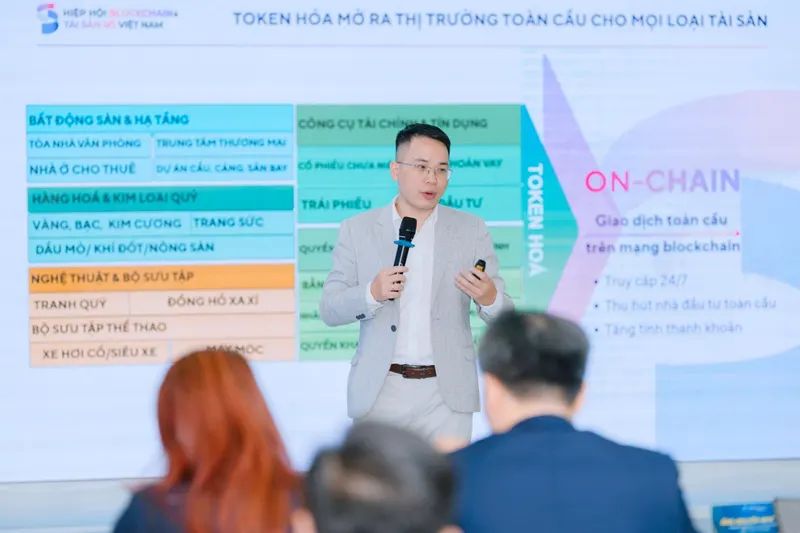
According to Mr. Nghiem Minh Hoang, the RWA market needs the legal framework and market infrastructure to converge, tied to a transparent risk management mechanism.
Risk Management Is the Top Priority
According to Mr. Nghiem Minh Hoang, RWA products, especially highly liquid assets such as tokenized gold, face 12 main risks in 3 groups: underlying asset risk, financial structure risk and technology risk.
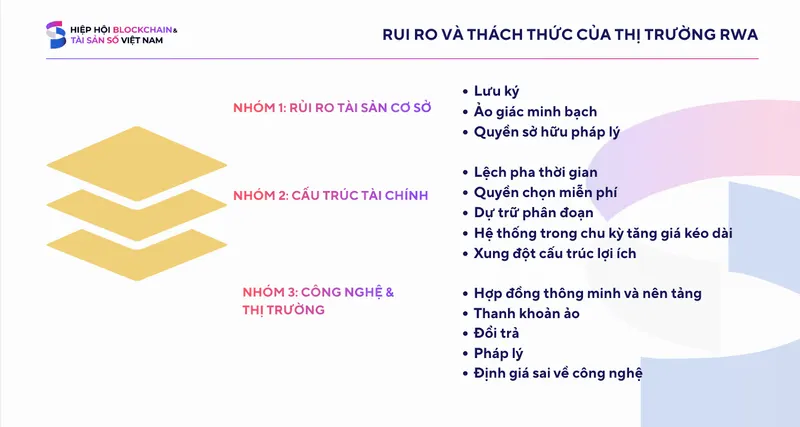
Three groups of risks and challenges in the RWA market. Source: VBA
First, underlying asset risk includes custody risk, the illusion of reserve transparency and legal ownership risk. When real-world assets are tokenized, the issued token depends entirely on the custodian, while a reserve audit is not a continuous verification mechanism and only reflects the position at certain points in time. Token holders usually do not legally own the asset directly and must queue behind priority creditors. If the issuer goes bankrupt, token investors have little chance of recovering the real assets.
Second, on financial structure risk, RWA models can give rise to many inherent risks. Collecting funds first and buying assets later creates a backing gap that investors find hard to detect. Token buyers may unwittingly give the issuer the option to choose when to buy, creating an imbalance of interests. In rising-price cycles, risk builds up when asset purchases are delayed. Moral hazard also arises if funds are not used for their stated purpose. Notably, fractional reserves can occur when the number of tokens issued exceeds the backing assets.
Third, at the technology and market layer, risk lies not only in the system but also in how it is operated. Liquidity on a digital platform may be only nominal, with no guarantee that tokens can be converted into real assets. Redemption mechanisms often come with restrictive conditions, high costs or long waiting times. Smart contract and technical infrastructure risks can arise during operation. Notably, overestimating the role of blockchain easily leads to misjudging the technology, since the system only secures data and does not verify assets off-chain. Meanwhile, a legal framework that is still being completed also adds compliance risk.
Dr. Kamal Anand, CEO of BIGOD, shared experience from gold tokenization, one of the pioneering assets in the RWA market. He stressed that the core of tokenizing any real-world asset lies in designing a multi-layered risk control system. The real asset must be held in separate custody with ownership clearly defined, backed by independent audit and verification mechanisms to ensure reserve transparency. On that foundation, blockchain is used to record and track transactions, while the financial application layer determines how the asset can operate.
“The challenge lies not in the technology, but in the ability to ensure authenticity, continuous verification and operating discipline, the factors that determine the model's trustworthiness and safety,” Dr. Kamal Anand said.
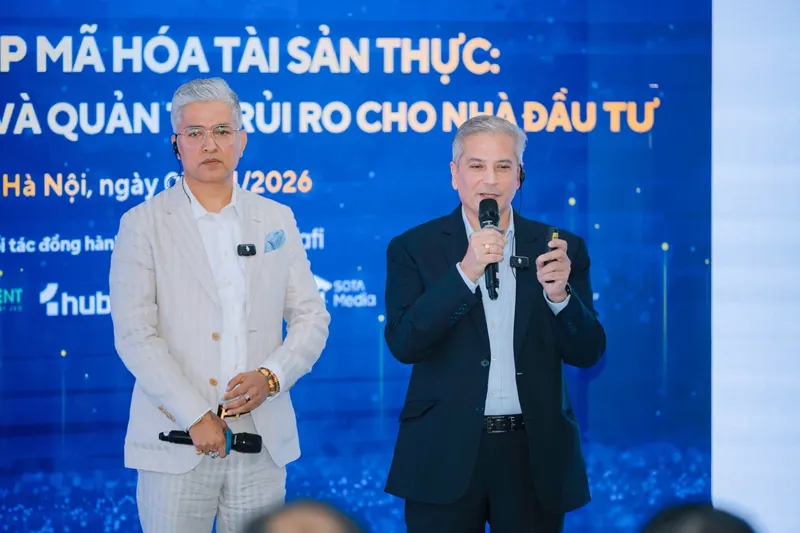
Dr. Kamal Anand (left) and Mr. Varun Chugh (right) share international experience in asset tokenization.
Compliance to Lead
In the panel discussion on balancing benefits, risk management and adaptation strategy in the RWA era, opinions focused on the need to standardize processes when real-world assets move onto digital infrastructure. RWA raises issues of property rights, custody and verification, calling for a completed legal framework, standardized processes and stronger oversight.
Mr. Varun Chugh, Financial Advisor at BIGOD, said RWA can trade continuously, update prices in real time and take part in many financial activities, rather than being limited like physical assets. In his view, however, this is a change in how assets are held, not a replacement for real assets. He noted three key points that need clarifying: the custody and audit mechanism, the legal status of the holder and the process for buying the backing assets.
From a market perspective, Mr. Luong Duy Phuoc, Director of Analysis at Kafi Securities Company, said RWA opens a notable approach by bringing real-world assets, or rights over them, onto a more transparent and flexible trading infrastructure. Tied to familiar assets such as gold, this model draws a degree of interest from Vietnamese investors.
However, the deciding factor is not the technology but risk management capacity. In his view, for investors, the biggest risk is not truly understanding the nature of the product, so the market needs to ensure a high level of transparency on property rights, backing mechanisms and liquidity. For issuers, the biggest challenge is maintaining market trust, which requires tight control of underlying assets, valuation methods and operating processes. For financial institutions, the key is to build an assessment framework clear enough to decide which opportunities are ready to pursue and which still need further monitoring and evaluation before entering.

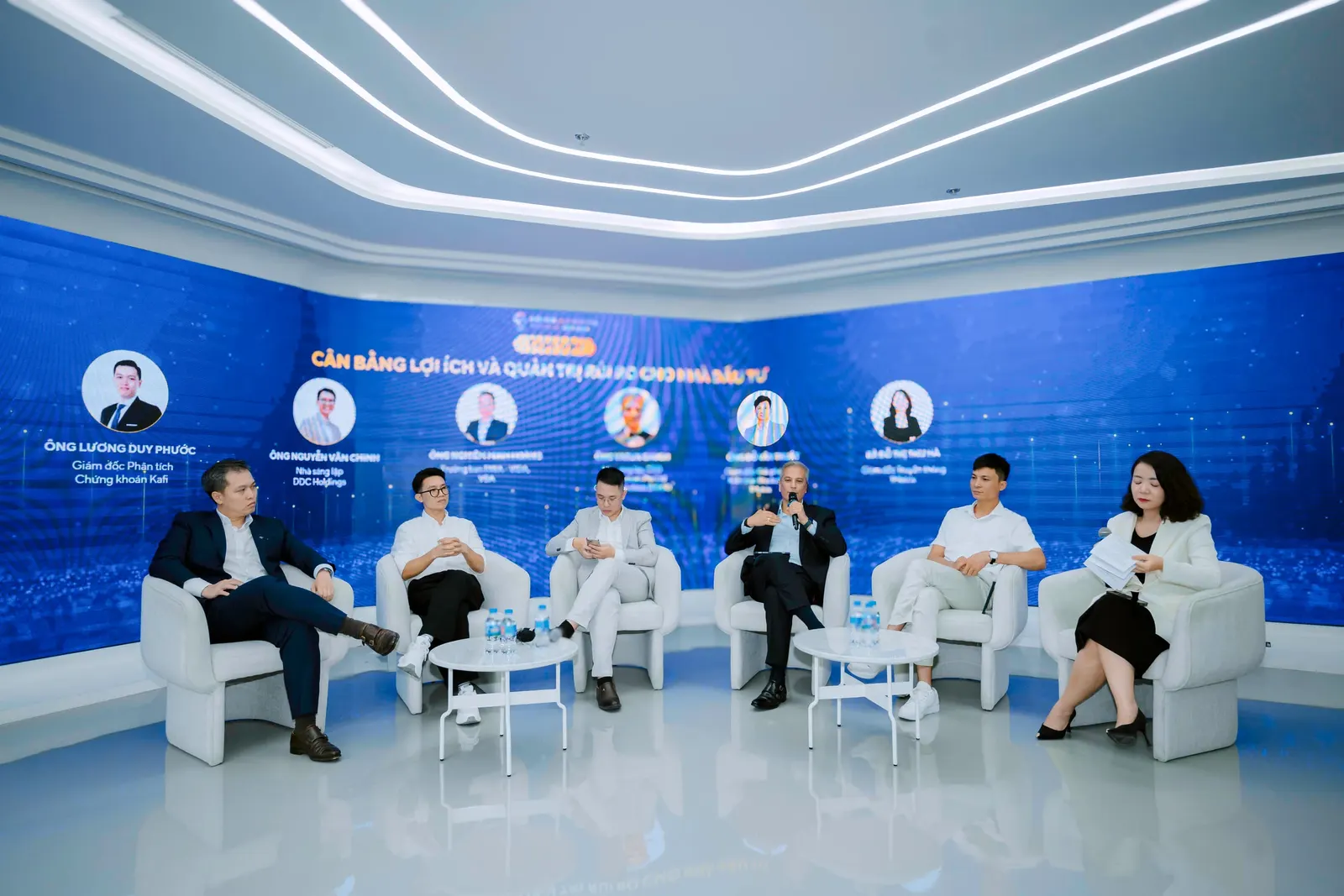
(Left to right) Mr. Luong Duy Phuoc, Mr. Nguyen Van Chinh, Mr. Nghiem Minh Hoang, Mr. Varun Chugh, Dr. Do Van Thuat and Ms. Do Thi Thu Ha discuss how to balance benefits and risk management for investors.
Meanwhile, Dr. Do Van Thuat, Director of Blockchain Solutions & Architecture at VMatrix, stressed that the central challenge is ensuring authenticity between real-world assets and on-chain data. This calls for a combination of reliable oracles (real-world data feeds), independent audit and rigorous technical standards, along with real-time price synchronization to sustain market trust.
Mr. Nguyen Van Chinh, Founder of DDC Holdings, said that, as with securities, investors come to RWA expecting growth from a new investment channel and a future asset class. In the early stage, investors should be cautious and start with small capital to experience the market, then realize profits once expectations are met and look for new opportunities. The key, however, is to assess opportunities and risks correctly when entering a new market such as RWA.
Summing up the roundtable, experts and speakers agreed that, for investors in the crypto asset market in general and RWA in particular, the biggest challenge is correctly identifying the nature of the product, which calls for transparency on property rights, backing mechanisms and actual liquidity. For issuers, the critical risk lies in tight control of underlying assets and in valuation and operating processes. Financial institutions, meanwhile, need to build an assessment framework clear enough to judge how suitable each opportunity is and when to enter.