


For the digital asset ecosystem to develop sustainably, three main pillars must be addressed at once: technology, operations and law. Security is not merely a technical requirement but must become a foundation that runs through the entire development process.
At the seminar “Financial Data Security in the AI Era,” organized by Vietnam Finance magazine on April 23, Dr. Do Van Thuat, Director of Blockchain Solutions & Architecture at VMatrix, said that digital assets are assets expressed as digital data, created, stored and traded in the electronic environment through digital technologies, most prominently blockchain.
The scope of digital assets includes virtual assets and crypto assets held for investment or exchange, but excludes traditional financial instruments such as securities or fiat currency in digital form. With their decentralized nature, transparency and cross-border tradability, digital assets are opening many new opportunities for the financial market, but they also bring unprecedented risk management challenges.
One prominent issue is risk at the user level, the weakest link in the entire ecosystem. Scams are growing more sophisticated, from disguised Ponzi schemes, fake e-wallets and impersonation of technical support teams to carefully designed “trap” projects aimed at investor psychology.
According to statistics he cited, in 2024 alone there were nearly 150,000 complaints related to cryptocurrency, with total losses of USD 9.3 billion, a sharp increase from the previous year. This shows that the level of risk is not limited to individuals but has spread across the whole market.
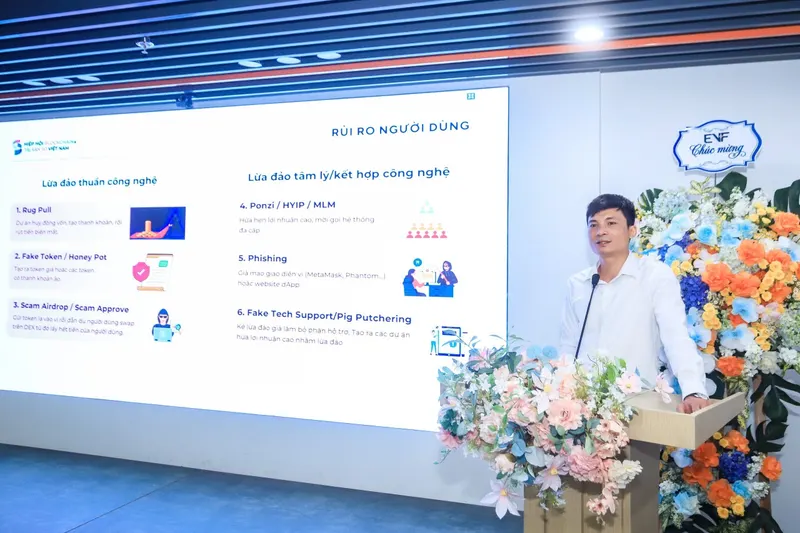
Dr. Do Van Thuat - Director of Blockchain Solutions & Architecture, VMatrix.
Beyond the user side, risk at the application level, particularly in smart contracts, is also seen as a worrying weakness. According to Dr. Thuat, technical vulnerabilities such as programming logic errors, reentrancy attacks, data manipulation or flaws in authorization mechanisms can be exploited to carry out large-scale attacks. In practice there have been many attacks on decentralized finance (DeFi) platforms, blockchain bridges and exchanges, causing losses of up to hundreds of millions of USD per incident, eroding investor confidence and creating a negative contagion effect across the market.
From an operations standpoint, Dr. Do Van Thuat said that many serious incidents do not originate in the core blockchain technology, which is designed with a high level of security, but mainly from off-chain factors, including private key management, wallet infrastructure, storage systems and internal approval processes. These weaknesses usually relate to people or processes, leaving systems exposed to attacks such as internal fraud, account takeover or exploitation of operational errors. According to statistics, the average loss in attacks on operational infrastructure can reach tens of millions of USD, which shows how serious this risk is.

Given this context, Dr. Thuat recommended building a multilayered defense mechanism that combines blockchain technology with traditional cybersecurity solutions. Under it, the management and storage of digital assets must follow strict principles: separating trading wallets from storage wallets, not keeping security information in online environments, applying multilayer authentication, and setting up multi-level approval processes with clear authorization. These are regarded as important layers of defense to minimize the likelihood of intrusion and limit the damage when incidents occur.
Beyond technology and operations, legal compliance is also becoming ever more urgent as anti-money laundering (AML) and know-your-customer (KYC) rules are tightened worldwide. Recent cases involving major exchanges show that legal risk affects not only an individual company but can also spread across the entire ecosystem. Building a clear, transparent legal framework in line with international practice is therefore key for the digital asset market to develop stably.

Dr. Do Van Thuat stressed that for the digital asset ecosystem to develop sustainably, three main pillars must be addressed at once: technology, operations and law. Security is not merely a technical requirement but must become a foundation that runs through the entire development process. Only by ensuring safety and transparency can the market strengthen investor confidence, attract capital and gradually establish its role in the global digital financial system.